In this article
the short answer
Compounded semaglutide and tirzepatide are the same active molecules as the brand-name products, made by a licensed compounding pharmacy for one patient's prescription. They are not generics. Safety depends on the pharmacy, which is why the source matters. Through Pepvio, a licensed U.S. physician prescribes them and a licensed U.S. pharmacy makes them.
Most of the confusion comes from three words that get used interchangeably: brand-name, generic, and compounded. They describe three different ways a medication reaches you, and the safety questions to ask about each are different.
This article covers what compounding is, how the compounded vial differs from the brand-name pen, why compounded is a separate category from generic, where the law stands, what the FDA's safety reports have actually described, what the cost difference looks like, and how a prescription works through Pepvio.
what compounded means
A compounding pharmacy prepares a medication for a specific patient, following a prescription from that patient's physician. It is routine medicine. Hormone therapy in a custom dose, a liquid version of a pill for someone who cannot swallow tablets, a medication made without a dye a patient is allergic to, and a child's dose of an adult drug are all compounded every day in the United States.
Compounding is regulated at two levels. The pharmacy is licensed and inspected by its state board of pharmacy. Federal law, section 503A of the Food, Drug, and Cosmetic Act, sets the conditions under which a pharmacy may compound: a prescription for an identified patient, a licensed pharmacist or physician doing the work, and active ingredients that come from an FDA-registered facility with a certificate of analysis documenting what is in the material and how pure it is.[4]
The pharmacy that makes Pepvio's compounded semaglutide and tirzepatide is a 503A pharmacy licensed in the United States. The prescription it fills has your name on it, and so does the label on the vial.
same molecule, different package
The active ingredient in compounded semaglutide is semaglutide, the same molecule as Ozempic® and Wegovy®. The active ingredient in compounded tirzepatide is tirzepatide, the same molecule as Mounjaro® and Zepbound®. These are the molecules that were studied in the trials the FDA reviewed: about 15 percent average weight loss over 68 weeks for semaglutide[1] and about 21 percent over 72 weeks at the highest dose of tirzepatide.[2]
The brand-name products come in a pre-filled pen that delivers a fixed dose with each click. The pen is the part you are paying for with the brand: the manufacturing, the device, and the marketing behind it.
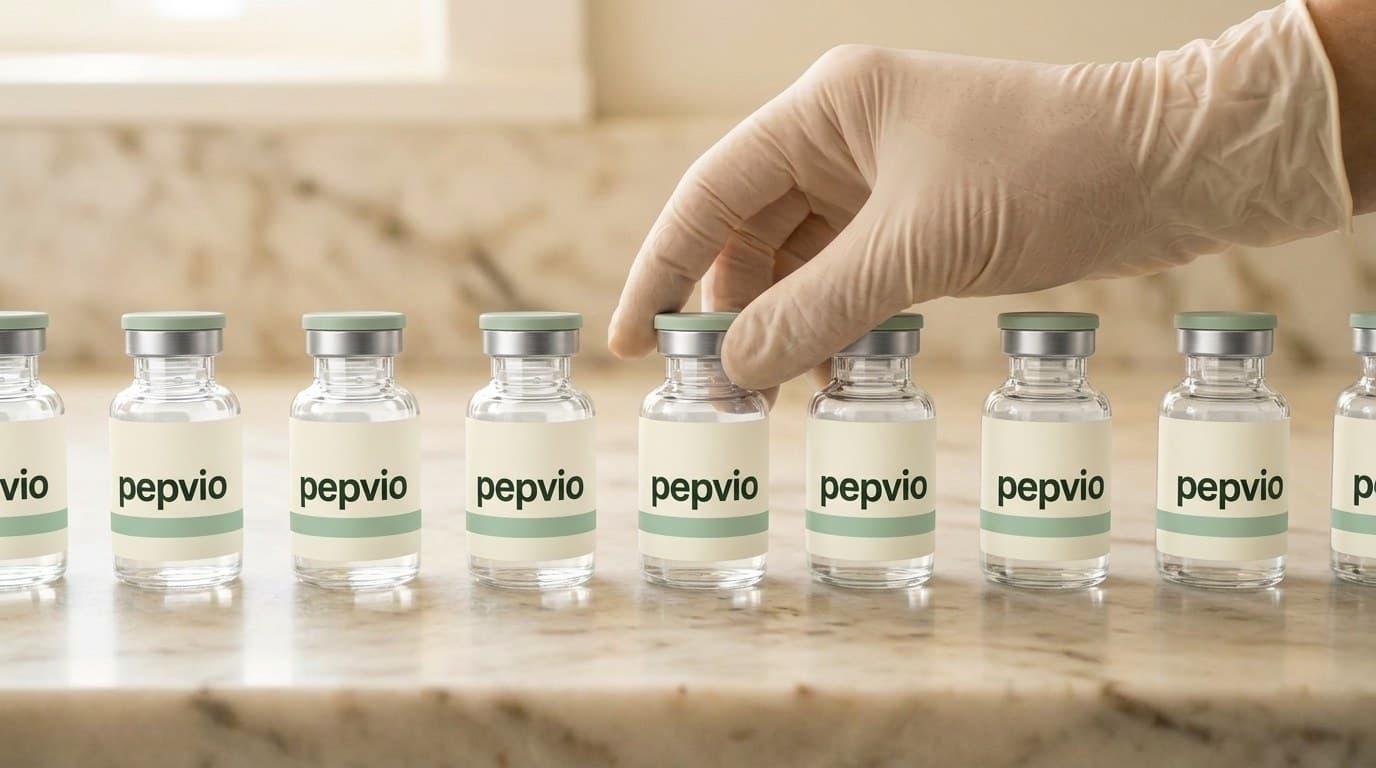
Compounded semaglutide and tirzepatide usually come in a small multi-dose vial. You draw each weekly dose with an insulin syringe, and the physician sets the dose by the number of units on that syringe. Some pharmacies supply a pen instead of a vial. Some compounded versions also contain vitamin B12 or a different preservative or buffer than the brand product; the pharmacy label lists everything in the vial.
One practical difference matters more than the others. The concentration of a compounded vial, how many milligrams of the drug are in each milliliter, varies from pharmacy to pharmacy. Your dose in units is calculated from your vial's concentration, so the units on your prescription apply to your vial and to no one else's. This is the reason the instructions come from your prescriber and your pharmacy, and the reason to ask before changing anything.
why it is not a generic
There is no generic semaglutide or tirzepatide in the United States. A generic is a copy of a brand-name drug that a manufacturer has taken through its own FDA approval, after the brand's patents expire, and that any pharmacy can then stock and sell. The patents on both of these molecules run for years yet.
Compounded medication is a different category. It is prepared for an individual prescription rather than manufactured in bulk for the shelf, and the pharmacy that makes it is accountable to its state board and to the physician who wrote the prescription. The compounded vs. generic guide walks through the three approval pathways side by side.
the legal status in one paragraph
Under section 503A, a licensed pharmacy may compound semaglutide or tirzepatide for an individual patient when the prescribing physician determines that the compounded preparation is appropriate for that patient. What ended in 2025 was the shortage period, during which FDA had allowed large-scale production of copies of the brand products while the manufacturers could not meet demand. The enforcement headlines since then have been about facilities that kept producing at that scale after the shortage was declared over. The compounded GLP-1 regulatory guide has the dates, the court decisions, and the 503A versus 503B distinction in full.
how to tell a legitimate source from a risky one
The molecule is the same wherever it comes from. The pharmacy is what varies. These are the checks that separate a licensed source from a risky one:
- A real prescription from a licensed physician, written after a health history. A physician reviews your medical history, current medications, and the conditions that rule these drugs out before prescribing. A site that sells without asking for one is skipping that step.
- A named, state-licensed U.S. pharmacy you can look up. Every state board of pharmacy publishes a license lookup. A legitimate provider tells you which pharmacy fills your prescription, and that pharmacy appears in its state's registry.
- A label with your name, the drug name, the strength, and a beyond-use date. The beyond-use date is the date after which the preparation should be discarded. A vial without one, or a label without your name, did not come from a pharmacy filling your prescription.
- The base form of the drug, not a salt. The FDA has stated that semaglutide sodium and semaglutide acetate, the salt forms, are not the same active ingredient as the approved drug and should not be used in compounding.[3] Ask if the ingredient is semaglutide or tirzepatide base.
- No "research use only" vials. That label means the product was never made for human use and no pharmacy or physician stands behind it.
- No crypto-only checkout, and no sales without a prescription. A licensed pharmacy takes ordinary payment and requires a prescription for every order.
How to tell a compounded prescription from the gray market covers the three categories that get confused in more detail.
what the safety record looks like
The molecule's side effects are the same in a compounded vial as in a brand pen: nausea, constipation, diarrhea, and reduced appetite, most often in the first weeks and after each dose increase, because the drug slows how fast your stomach empties. These are the effects the trials measured and the ones your physician reviews with you before you start.[1][2]
The FDA's reports about compounded GLP-1 products specifically fall into two groups.[3] The first is dosing errors: patients measuring and injecting the wrong amount from a vial, in some cases a prescriber miscalculating the dose, and in others a dose or dose schedule beyond what the approved label allows. The FDA describes some of these as requiring hospital care. The second is products from sources that were never licensed pharmacies, including vials with fake labels carrying the name of a real pharmacy that never made them, and products made from the salt forms described above.
Both groups point back to the same two things. A physician who tells you your dose in units, explains what that number means for your vial, and answers the question again when you ask, covers the first. A named, state-licensed pharmacy with your name on the label covers the second. The FDA also advises using a new sterile needle and syringe for every dose and discarding a vial 28 days after first use.[3] Your pharmacy's beyond-use date and your prescriber's instructions take precedence over anything written on a forum.
cost, plainly
Compounded semaglutide and tirzepatide cost a fraction of the brand-name list price, which is the reason most people look into them. The brand price pays for the pen, the manufacturer's marketing, and the margin on a patented product. A compounded prescription pays for the pharmacy's work and the ingredient.
The number to watch is what happens to the price as your dose goes up. Both drugs start low and increase in steps over the first several months, and many compounded providers charge more at each step, so the monthly price at your maintenance dose can be well above the one you signed up at.
Pepvio's Price Lock keeps the same monthly price at every dose, with no increase when your dose steps up and no increase in the second year. The GLP-1 protocol page has the current prices, and the GLP-1 cost calculator shows what a full course costs at each dose compared with the alternatives.
how it works at Pepvio
The online visit takes about 2 minutes: your health history, current medications, and what you are hoping to change. A licensed U.S. physician reviews it and decides whether semaglutide or tirzepatide is appropriate for you and, if so, at what starting dose. You are charged only after the physician approves.
A licensed U.S. compounding pharmacy then prepares your prescription and ships it to you, with your name, the drug, the strength, and the beyond-use date on the label. Your dose comes as a number of units on the syringe, and the care team is there to walk through it. If you are unsure what a number means or where to inject, message them before your first dose.
The tirzepatide weight-loss guide covers what to expect month by month once you start. If you are ready to find out whether a GLP-1 medication is appropriate for you, the visit is below.
---
Sources & references
- [4]U.S. Food and Drug Administration. "Compounding and the FDA: Questions and Answers." FDA.gov ↩
- [1]Wilding JPH, Batterham RL, Calanna S, et al. "Once-Weekly Semaglutide in Adults with Overweight or Obesity." N Engl J Med. 2021;384(11):989-1002. PubMed ↩
- [2]Jastreboff AM, Aronne LJ, Ahmad NN, et al. "Tirzepatide Once Weekly for the Treatment of Obesity." N Engl J Med. 2022;387(3):205-216. PubMed ↩
- [3]U.S. Food and Drug Administration. "FDA's Concerns with Unapproved GLP-1 Drugs Used for Weight Loss." FDA.gov ↩
Frequently asked questions
Is compounded semaglutide the same as Ozempic?
The active ingredient is the same molecule, semaglutide. Ozempic and Wegovy are brand-name products sold in a pre-filled pen at fixed doses. Compounded semaglutide is prepared by a licensed compounding pharmacy for your individual prescription, usually in a vial you draw from with an insulin syringe at the dose your physician sets. Pepvio prescribes compounded semaglutide; it does not sell the brand-name products.
Is compounded tirzepatide safe?
The molecule is the one studied in the FDA-reviewed trials, and its side effects are the same as the brand product: mostly nausea and other stomach effects early on and after dose increases. The safety questions specific to compounded tirzepatide are about the source. The FDA's reports have involved dosing errors with unfamiliar syringes and products from sellers that were not licensed pharmacies. A prescription from a licensed physician who explains your dose in units, and a vial from a named, state-licensed U.S. pharmacy with your name on the label, address both.
Why is compounded semaglutide cheaper?
The brand-name price covers the pre-filled pen, the manufacturer's marketing, and the margin on a patented product. A compounded prescription covers the pharmacy's work and the ingredient, prepared for your prescription rather than mass-produced. Many compounded providers raise the price as your dose goes up; Pepvio's Price Lock keeps the same monthly price at every dose.
Is compounded semaglutide FDA-approved?
The molecule, semaglutide, is the active ingredient in FDA-approved products. Compounded preparations themselves are not individually FDA-approved, which is true of every compounded medication, from custom-dose hormone therapy to children's liquid formulations. They are regulated instead through the pharmacy: state licensing and inspection, federal requirements under section 503A, and FDA-registered ingredient suppliers with certificates of analysis.
How do I know a compounding pharmacy is legitimate?
Ask which pharmacy fills your prescription and look it up in that state's board of pharmacy license registry. The vial should arrive with a label showing your name, the drug name, the strength, the pharmacy name, and a beyond-use date. The ingredient should be semaglutide or tirzepatide base rather than a salt form. Anything sold without a prescription, labeled for research use only, or paid for only in cryptocurrency did not come through a licensed pharmacy.
This article is for general information and is not medical advice. Pepvio treatments are prescription medications: a licensed US physician reviews every intake and prescribes only when clinically appropriate. Individual results vary.
Ready to get started?
A short intake form, reviewed by a licensed U.S. physician. You're only charged if a prescription is written.
See if GLP-1 is right for meKeep reading
GLP-1 Face: Why Fast Weight Loss Changes Your Face, and How to Keep Muscle on a GLP-1
The drawn look people call GLP-1 face comes from losing facial fat quickly, which reveals the elasticity the skin had already lost with age. It happens with any fast weight loss, and the speed is the part you can change. Here is what changes in the face, why muscle matters more, and how to protect both.
Read articleDo Peptides Actually Work?
Short answer: yes, for the right person and the right protocol. The harder question is which one would actually help you. Here's a plain-English walk-through of what each of our protocols does, who it's for, and what's reasonable to expect.
Read articleWhat Are Peptides? A Plain-Language Guide to the Ones Doctors Actually Prescribe
Peptides are short chains of amino acids that your body uses as signals. A few are prescription medications with decades of use: sermorelin for sleep and recovery, PT-141 for desire, and the GLP-1 medications for weight. Here is what a peptide is, how the prescribed ones work, and how they differ from what is sold online.
Read article