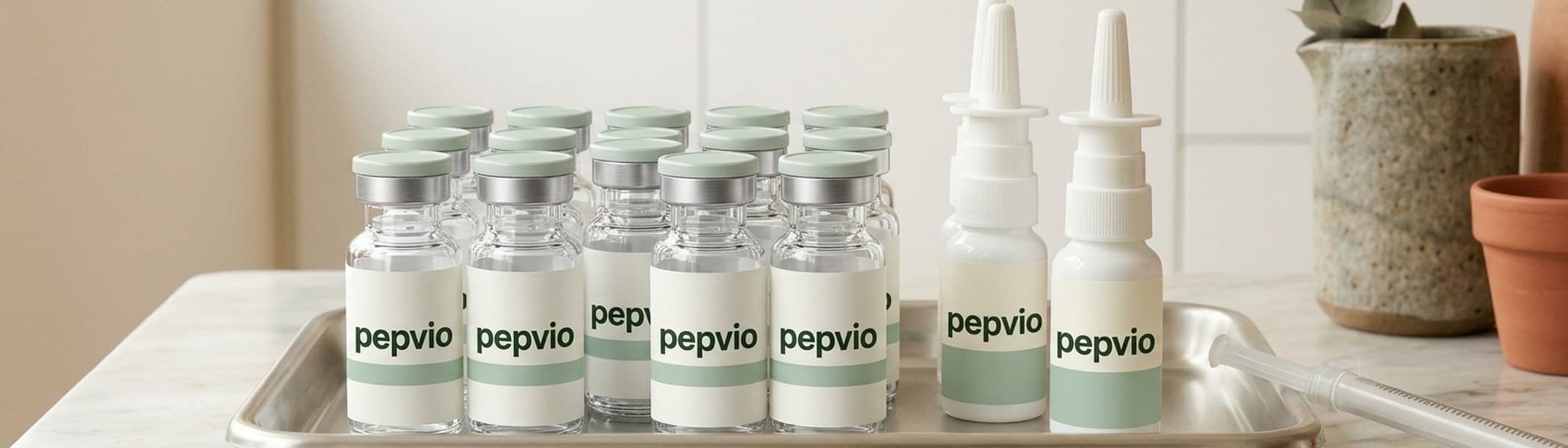
Compounded medication, not FDA-approved
This article discusses compounded medications that are not FDA-approved products. Compounded medications are prepared by licensed 503A/503B pharmacies based on a licensed provider's prescription. They are not evaluated by the FDA for safety or efficacy. Nothing in this article constitutes medical advice, diagnosis, or a recommendation to use any product. All prescribing and dosing decisions are made by a licensed physician during intake.
In this article
- 01why compounded GLP-1s became a massive category
- 02the 503A vs 503B distinction that matters
- 03the shortage framework and its closure
- 04what FDA enforcement has actually looked like
- 05where legitimate compounded GLP-1 use still exists
- 06what this means for the telehealth industry
- 07why this matters for readers in other categories
- 08the takeaway
why compounded GLP-1s became a massive category
If you've been watching the telehealth landscape over the last three years, you've seen compounded GLP-1 weight-loss offerings become one of the largest consumer health categories in the country. Hundreds of telehealth platforms, some branded specifically for weight management and others expanding existing hormone or primary care businesses, have sold compounded semaglutide and compounded tirzepatide to millions of US patients at prices substantially below what branded Ozempic, Wegovy, Mounjaro, or Zepbound would cost out-of-pocket.
This didn't happen by accident. It happened because a specific regulatory mechanism (the FDA drug shortage list) created a time-limited window in which 503A compounding pharmacies could legally produce otherwise patented medications for patient prescribing. Semaglutide was added to the FDA shortage list in 2022. Tirzepatide followed in 2022 as well. During the shortage period, the FDA allowed compounded versions to fill a real supply gap in a drug everyone wanted.
That regulatory window has been closing. In October 2024, the FDA declared the tirzepatide shortage resolved. In February 2025, the agency declared the semaglutide shortage resolved as well. The formal framework under which mass compounding of GLP-1s had operated changed meaningfully as a result.
This article is a careful look at what's actually happened since, what the current enforcement landscape looks like, and why this matters even for readers who aren't in the GLP-1 business, because the regulatory framework on display here is the same one that governs compounded medicine broadly.
the 503A vs 503B distinction that matters
Before going further, a distinction that most popular coverage elides but that matters a lot. US compounding pharmacies are governed by two different sections of the Federal Food, Drug, and Cosmetic Act:
503A compounding pharmacies. These are traditional patient-specific compounding pharmacies. They are licensed by state boards of pharmacy and produce compounded medications in response to individual prescriptions for specific patients. They operate under USP 795 and USP 797 compounding standards. They are not registered with the FDA for manufacturing.
503B outsourcing facilities. These are federal-registered facilities that can produce compounded drugs in batches, without patient-specific prescriptions, under cGMP (current Good Manufacturing Practice) standards that approach pharmaceutical manufacturing. They are inspected by the FDA. There are approximately 80 of them in the US.
The 503A pathway is what most telehealth GLP-1 operations have used. The 503B pathway is more restrictive and more expensive to operate at. During the shortage period, both pathways were legally permitted to produce compounded GLP-1s, but under somewhat different conditions and standards.
This matters for understanding enforcement because the FDA's authority and enforcement posture toward 503A and 503B facilities differ. The FDA has direct inspection and registration authority over 503B facilities. It has more limited authority over 503A pharmacies, which are primarily state-regulated. The enforcement actions that have emerged during the shortage-resolution period have targeted both pathways but through different mechanisms.
the shortage framework and its closure
Under section 503A of the FDCA, compounding pharmacies generally cannot produce 'essentially copies' of commercially available FDA-approved drugs. There's an exception: when a drug appears on the FDA's drug shortage list, 503A pharmacies are permitted to produce it for patient prescribing during the shortage.
Semaglutide and tirzepatide were added to the shortage list in 2022 as demand for the brand-name versions (Ozempic, Wegovy, Mounjaro) outran what Novo Nordisk and Eli Lilly could make. This opened the compounding pathway that fueled the telehealth GLP-1 boom.
Tirzepatide (Mounjaro, Zepbound): Removed from the shortage list by FDA on October 2, 2024.[1] The FDA subsequently clarified timeline expectations for 503A and 503B facilities to stop compounding tirzepatide, with staggered deadlines through early 2025 giving facilities time to wind down patient-specific prescriptions and transition patients.
Semaglutide (Ozempic, Wegovy): Removed from the shortage list by FDA on February 21, 2025.[1] The FDA set timelines for 503A facilities to cease compounding semaglutide by April 2025 and 503B facilities by May 2025.
Industry pushback was significant. The Outsourcing Facilities Association and several compounding pharmacy trade groups filed legal challenges to the shortage-resolution declarations, arguing that supply of the branded products was still inadequate.[2] A federal court denied an injunction in March 2025 that would have extended the compounding window. The regulatory framework as of 2026 is: the shortage is officially resolved, and the compounding window that existed during 2022-2024 has largely closed.
what FDA enforcement has actually looked like
With the shortage resolved, the question is: what is the FDA actually doing to enforce against continued compounded GLP-1 operations? A few threads have emerged.
Warning letters. The FDA has issued warning letters to specific 503A compounding pharmacies and to telehealth platforms making claims that the FDA considers unsupported or out of compliance with post-shortage regulatory expectations.[3] These letters identify specific violations: unapproved new drug claims, misbranding, compounding from non-pharmaceutical-grade sources, or specific marketing claims that go beyond what off-label prescribing supports.
Bulk substance enforcement. The FDA has also increased scrutiny of the source of the semaglutide and tirzepatide bulk active pharmaceutical ingredient (API) being used in compounding operations. Legitimate compounding requires USP-grade or FDA-approved API. A significant portion of the GLP-1 compounding supply has historically come from sources whose regulatory status is less clear: Chinese API manufacturers whose registration status with the FDA is either pending or absent, and whose quality control does not meet US pharmaceutical grade.
Adverse event data. The FDA has received a growing volume of reports of bad reactions to compounded GLP-1 products. Some of these reflect expected adverse events from GLP-1 therapy (nausea, vomiting, pancreatitis, gallbladder issues). Some reflect dosing errors related to compounded product concentration differences from the branded products. Some reflect contamination, mislabeling, or other compounding pharmacy quality control issues that have emerged as enforcement has tightened.
State board coordination. Because 503A facilities are state-licensed, the FDA has increasingly coordinated with state pharmacy boards to address specific compounding pharmacy operations that the FDA considers out of compliance with post-shortage expectations.
Rhetorical posture. The FDA has said openly that, now that the shortage is over, compounding semaglutide and tirzepatide is mostly off the table, while acknowledging narrow exceptions (genuine clinical need for a non-standard formulation, documented patient-specific medical need that branded product can't meet). The public statements emphasize patient safety and the importance of FDA-approved product over compounded alternatives.
where legitimate compounded GLP-1 use still exists
Even in the post-shortage framework, there are narrow cases where compounded semaglutide or tirzepatide may still be legitimately prescribed under 503A compounding. The key exception: patient-specific medical necessity for a formulation that the branded product cannot provide.
Examples that practicing clinicians and compounding pharmacies have identified:
- A patient with an allergy to a specific inactive ingredient in the branded product, where a compounded formulation with different excipients may be medically necessary.
- A patient requiring a specific non-standard dose titration that the branded product's available strengths don't permit.
- A patient requiring an alternate delivery route or formulation that the branded product doesn't offer.
These exceptions are narrow and require documented patient-specific medical rationale. They are not a pathway for mass-market compounding of cheaper GLP-1s for general weight-loss use.
The telehealth industry's framing of 'patient-specific customization' (adding a small amount of B12 to compounded semaglutide, for example, and claiming this constitutes a non-copy compound that justifies ongoing compounding under 503A) has been specifically addressed by the FDA as an insufficient basis to continue mass compounding post-shortage. Regulators have been clear that small tweaks don't get you out of the rule against making knock-offs of approved drugs.
| Framework element | Shortage period (2022-2024) | Post-shortage (2025 onward) |
|---|---|---|
| 503A compounding of semaglutide | Permitted | Generally not permitted; narrow patient-specific exceptions |
| 503A compounding of tirzepatide | Permitted | Generally not permitted; narrow patient-specific exceptions |
| 503B outsourcing facility production | Permitted with FDA inspection | Generally not permitted post-deadlines |
| 'Essentially a copy' exemption via trivial modification | Contested | FDA has publicly rejected this framing |
| Enforcement focus | Quality and source of API | Source of API, marketing claims, ongoing production |
| Market landscape | Rapid expansion | Contraction, consolidation, pivoting to branded prescribing |
what this means for the telehealth industry
The contraction of the compounded GLP-1 market has had significant effects on the telehealth industry that grew up around it. A few patterns worth naming:
Pivot to branded prescribing. Many telehealth platforms that built their businesses on compounded GLP-1s have pivoted to prescribing branded Wegovy, Zepbound, and related products. The economics are different. The patient out-of-pocket cost is higher, insurance coverage is variable, and platform margins compress. Some platforms have made this transition smoothly; others have struggled.
Consolidation. The fragmentation of the compounded GLP-1 telehealth market has given way to consolidation. Platforms with strong brand recognition and pharmacy relationships have absorbed smaller operators; others have exited the space entirely.
Ongoing gray-zone operators. Despite the regulatory changes, a tail of gray-zone operators continues to produce and ship compounded GLP-1s, often using imported API from sources with questionable regulatory status. For consumers, this tail is increasingly risky. The combination of regulatory exposure, quality uncertainty, and potential for contamination makes 'just find a compounder who will ship it anyway' a meaningfully different proposition than it was in 2023.
Adjacent category expansion. Some telehealth platforms that built distribution in GLP-1s have expanded into adjacent categories: peptide therapy, longevity, hormone optimization. This is part of how the telehealth world keeps shifting; the GLP-1 boom paid for the plumbing (pharmacies, prescriber networks, software) that's now being pointed at other categories.
Key Takeaway
why this matters for readers in other categories
Even for a reader who isn't interested in GLP-1s specifically, the compounded GLP-1 story is worth understanding because it illuminates several general principles about how legitimate compounding works.
Shortage-based compounding is time-limited. Compounding based on a drug shortage exemption is not a permanent pathway. When the shortage resolves, the compounding permission closes. This applies to any drug on the shortage list, not just GLP-1s.
Source of API matters. Legitimate compounding requires USP-grade or FDA-registered bulk active pharmaceutical ingredient. Cheap product typically reflects cheap API, and cheap API often reflects sources whose regulatory status is not what consumers assume.
'Patient-specific customization' has limits. Compounding is legitimate for patient-specific medical needs. It is not a general-purpose workaround for accessing cheaper versions of branded products. Regulators have been consistent in this framing, and the compounded GLP-1 industry's attempts to expand what counts as patient-specific customization have been rejected.
The 503A / 503B distinction matters. For any compounded prescription, understanding whether the compounding facility is a 503A traditional compounder or a 503B outsourcing facility is relevant. Both are legitimate pathways, but they operate under different standards, and for higher-volume or more complex products, 503B facilities offer regulatory assurances that 503A facilities don't match.
The compounded peptide and hormone categories generally operate under different regulatory frameworks than compounded GLP-1s, not under a shortage exemption, and in most cases without any FDA-approved equivalent. The regulatory picture for each compounded product category is specific, and collapsing them all into 'compounded' obscures meaningful differences.
For related reading on how compounded and generic drugs actually differ, see our compounded vs generic layperson's guide. For the broader picture of legitimate peptide compounding under the current Category 1 / Category 2 framework, see where to buy peptides legally.
the takeaway
The compounded GLP-1 story is not a story of a scam category. During the shortage period, compounded semaglutide and tirzepatide filled a real clinical need at a time when branded supply was genuinely inadequate. Many patients were helped by that access who would not have been helped waiting for branded supply to catch up.
It's also not a story of permanent legitimacy. The shortage-based compounding mechanism is narrow and time-limited, the post-shortage regulatory framework does not permit mass-market compounded GLP-1s to continue, and consumers buying low-cost compounded GLP-1s in 2026 are increasingly buying from operations whose regulatory posture is more precarious than the marketing suggests.
For a thoughtful reader navigating this space in 2026, the practical advice is: if you need GLP-1 therapy, work with a physician, use branded product when it's available and you can afford it, and understand that the aggressive discount-GLP-1 telehealth market is operating in a regulatory environment that has changed substantially from the 2022-2024 window when it emerged. The story the FDA is telling isn't complicated. It's just harder to hear over the noise of platforms still trying to operate as if the shortage framework is still in effect.
Sources & references
- [1]US Food and Drug Administration. FDA Drug Shortages database, historical records for tirzepatide (resolved October 2, 2024) and semaglutide (resolved February 21, 2025). Available at accessdata.fda.gov/scripts/drugshortages. ↩
- [2]Outsourcing Facilities Association et al. v. FDA, litigation filed in the United States District Court for the Northern District of Texas, 2025, challenging the tirzepatide and semaglutide shortage-resolution determinations. Preliminary injunction denied March 2025. ↩
- [3]FDA Warning Letters database. The FDA publishes warning letters issued to compounding pharmacies and to manufacturers making unapproved drug claims at fda.gov/inspections-compliance-enforcement-and-criminal-investigations/warning-letters. ↩
This article is for general information and is not medical advice. Pepvio treatments are prescription medications: a licensed US physician reviews every intake and prescribes only when clinically appropriate. Individual results vary.
Ready to explore peptide therapy and hormone optimization?
Take our 2-minute health assessment to see which Pepvio protocol fits your goals. A licensed provider reviews every response.
Find My ProtocolKeep reading
Are Peptides Legal in 2026? What the 503A/503B Framework Actually Means for Patients
The regulatory picture for peptides has moved around a lot over the past few years. Here's what's legal, what the 503A/503B compounding framework actually looks like, and how to access peptide therapy the right way in 2026.
Read articleLibido Booster for Women: What Actually Works
Most products marketed as libido boosters have weak or no clinical evidence. Here's what actually changes female desire, from hormones to FDA-approved prescription options, and how to figure out where to start.
Read articleSermorelin and Sleep: How It Works and What to Expect
Better sleep is usually the first thing people notice on sermorelin, often starting in weeks two or three. Here's the mechanism behind it, what the timeline looks like, and what tends to follow.
Read article