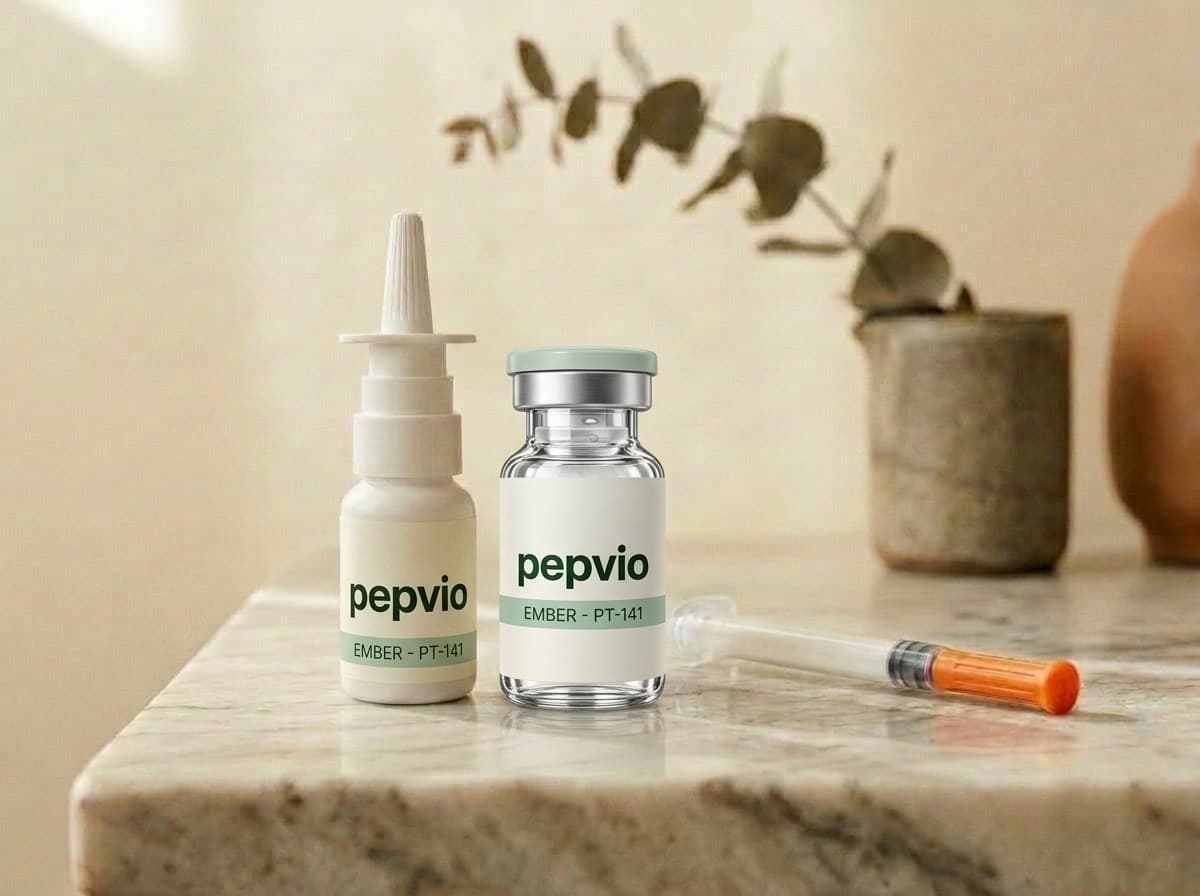
what you may notice
Everyone responds to PT-141 differently. Some women notice nothing beyond the intended effect. Others experience mild nausea, flushing, or a headache in the hours after a dose. In the FDA approval trials, most side effects that did occur were mild to moderate and passed within a few hours.
PT-141 (bremelanotide) was FDA-approved as Vyleesi in June 2019 based on the RECONNECT phase 3 trials, so its profile is documented in clinical data rather than anecdote. In those trials, roughly 4 in 10 women reported nausea at some point, which means the majority did not. About 1 in 5 reported flushing. Roughly 1 in 8 noticed irritation at the injection site, and about 1 in 9 reported a headache.
Your experience may not resemble any of these. Some women find their first dose entirely uneventful. Some notice more the first time and less on later doses. Some notice a mild effect consistently. There is no single pattern that holds for everyone, which is part of why the first few doses are worth treating as information about how your own body responds.
making your first dose comfortable
If you want to reduce the chance of nausea, a few things may help:
Eat something light beforehand. Taking PT-141 on an empty stomach can make nausea more likely for some people, and so can taking it right after a large meal. A light meal 30 to 60 minutes ahead is a reasonable middle ground.
Keep the timing tight. PT-141 is typically taken about 45 minutes before sexual activity. Taking it much earlier than that does not add benefit and can widen the window in which you might notice side effects.
Ask your provider about an anti-nausea option. Some providers suggest an over-the-counter anti-nausea medication taken 30 to 60 minutes before the injection, particularly for the first few uses. This is worth raising during your intake.
Talk through your starting dose. The standard dose is 1.75 mg. Depending on your situation, your provider may suggest starting lower.
None of these are requirements. Plenty of women take PT-141 without any special preparation and do fine. They are simply levers available if you want them.
what these effects can feel like
Nausea, when it occurs, often peaks within the first hour and typically eases within two to three hours. Most women who experience it describe it as mild to moderate rather than severe.
Flushing can present as warmth and redness in the face and chest. It usually resolves on its own within a few hours and does not typically require treatment.
Headache, when reported, is usually mild. Staying hydrated before and after a dose may help.
Injection site irritation can show up as minor redness or discomfort where the injection was given. Rotating sites tends to reduce it.
These effects trace back to how PT-141 works. It activates melanocortin receptors in the central nervous system, which is the same activity that produces the intended effect on desire and arousal. The receptors involved also influence things like vascular tone, which is why flushing and nausea show up for some people and not others.
what to talk through with your provider
PT-141 can cause a brief, transient rise in blood pressure in the hour after a dose. In the RECONNECT trials the average systolic increase was modest, around 6 mmHg, peaking near 12 minutes and returning to baseline well within the same day. For most healthy adults this is not clinically meaningful, but it does matter if you have hypertension or a cardiovascular history. The FDA label includes a contraindication for cardiovascular disease, and PT-141 is not combined with nitrates or other blood pressure lowering medications.
Hyperpigmentation, meaning darkening of skin on the face, gums, or breasts, was reported in about 1% of trial participants, concentrated among those using PT-141 more often than recommended. PT-141 is designed as an as-needed protocol rather than a daily one, and within the recommended frequency the reported risk is low. Where it did occur, it was described as reversible after stopping.
Providers also ask about pregnancy and any history of melanoma before prescribing.
These are the things the physician reviewing your intake is looking at. The purpose is to confirm PT-141 is a good match for your health history, not to create hurdles.
why pt-141 works differently
Most treatments for low desire work through hormones, adjusting estrogen, testosterone, or other systemic levels over weeks. PT-141 works through a different route. It acts on melanocortin receptors in the brain, on the pathway involved in sexual desire and arousal directly.
For women whose primary concern is desire rather than a hormonal imbalance or a physical comfort issue, that distinction can matter. PT-141 addresses the pathway more directly than approaches that work by shifting hormone levels.
The side effects some women notice are a byproduct of that same direct mechanism. That is also why the physician reviews your history first: the goal is matching the medication to the people it fits well.
If you are considering PT-141, your intake is the place to ask specific questions about how it might work for your situation.
Frequently asked questions
What side effects can PT-141 cause?
In the RECONNECT trials, roughly 4 in 10 women reported nausea, about 1 in 5 reported flushing, roughly 1 in 8 noticed injection site irritation, and about 1 in 9 reported a headache. Most were mild to moderate and passed within a few hours. Many women experience none of these, and individual response varies considerably.
How can I reduce the chance of nausea on PT-141?
Eating a light meal 30 to 60 minutes before the injection may help, as can avoiding an empty stomach or a large meal right beforehand. Some providers suggest an over-the-counter anti-nausea medication before the first few uses. Worth discussing with your prescribing physician during intake.
Does the first dose feel different from later ones?
It varies. Some women notice more on their first dose and less on subsequent ones as their body adjusts. Others notice no difference between doses, and some notice nothing at all. There is no universal pattern, so the first few doses are best treated as information about your own response.
Does PT-141 raise blood pressure?
It can cause a brief rise in blood pressure, typically peaking around 12 minutes after a dose and returning to baseline the same day. The average increase in trials was modest in healthy adults. It is a meaningful consideration if you have hypertension or cardiovascular disease, which is why your physician reviews this before prescribing.
How often can I use PT-141?
PT-141 is designed for as-needed use rather than daily. The recommended frequency is no more than once every 24 hours and no more than 8 times per month. Using it more often than recommended is associated with a higher reported rate of hyperpigmentation. Your provider will set the right frequency for your situation.
Is PT-141 safe for women?
PT-141 (bremelanotide / Vyleesi) was FDA-approved in June 2019 specifically for premenopausal women with hypoactive sexual desire disorder, based on clinical trial data in women. It is not appropriate for everyone, and a physician reviews your health history, including cardiovascular history and current medications, before prescribing.
This article is for general information and is not medical advice. Pepvio treatments are prescription medications: a licensed US physician reviews every intake and prescribes only when clinically appropriate. Individual results vary.
Ready to get started?
A short intake form, reviewed by a licensed U.S. physician. You're only charged if a prescription is written.
See if PT-141 is right for meKeep reading
Testosterone Pellets vs Cream vs Injection: The Real Tradeoffs for Women
Off-label testosterone prescribing for women uses three primary delivery methods: compounded cream, implanted pellets, and injection. Each has real tradeoffs around dose adjustability, convenience, and the specific physiology of what's being delivered. An educational comparison of what the clinical literature and prescribing practice describe.
Read articlePT-141 (Bremelanotide) for Female Desire: The Only FDA-Approved Peptide for HSDD
PT-141 (bremelanotide) is the only FDA-approved peptide for female desire: a central-acting melanocortin receptor agonist approved in 2019 for generalized hypoactive sexual desire disorder. Here's how it works, what the trial data actually shows, and where it fits in a thoughtful women's sexual health protocol.
Read articleThe 3 AM Wake-Up Club: What Perimenopause Does to Your Cortisol
If you fall asleep fine but wake up at 3 AM with a racing heart and a brain that won't shut off, you're not stressed. You're in a very specific perimenopausal pattern with a very specific name. Here's what's actually going on.
Read article