if your libido dropped after starting the pill
It's one of those things women rarely say out loud: desire fades sometime after starting birth control, nobody connects the dots for months, and by the time you do, you're left wondering whether it's the pill, your relationship, or you.
The real answer: for some women, hormonal birth control really does lower desire, and there's a clear, physical reason it happens. Here's what's going on, why it hits some women and not others, and what you can do about it.
why it happens: it comes down to testosterone
Testosterone helps drive desire in women too, just at lower levels than in men. Combined birth control (the pill, patch, and ring) lowers the testosterone your body actually has to work with, in two ways.
First, it quiets your ovaries' own testosterone production. Second (and this is the bigger one), the estrogen in these methods raises a protein called SHBG (sex hormone-binding globulin). Think of SHBG as a sponge: it soaks up testosterone in your blood so less of it is free to do its job. More SHBG, less free testosterone. Studies have found SHBG several times higher in women on the combined pill, and in some women it stays up for a while even after they stop.[1]
So when desire does dip, it isn't in your head. It traces back to a real, measurable change.
why it affects some women and not others
Here's what makes it confusing: most women on hormonal birth control notice no change in desire. Some even feel it go up, often because not having to worry about pregnancy is freeing in itself. And a smaller group feels it drop. The studies that find a drop put it somewhere around 23 to 30 percent of users: real, but far from everyone.
What seems to set those groups apart is how sensitive you are to that testosterone change, your baseline hormones, and the exact method you're on. The bottom line for you is simple: your own experience counts for more than the average. If your desire fell after you started a particular method, that's worth taking seriously.
what your options are
If the timing points at your birth control, you've got a few directions, and the first stop is the provider who manages your contraception.
- Switch the formulation. Different pills raise SHBG by different amounts. A lower-estrogen pill, a different progestin, or a non-pill method can change things for some women.
- Try a non-hormonal method. If you want to test whether the pill is really the cause, switching to something non-hormonal (like a copper IUD) and seeing how you feel over a couple of months is about as clean a test as you'll get.
- Treat the desire directly. If you need or want to stay on hormonal birth control and desire is still low, that's where a desire-specific option comes in.
Which move is right depends on what matters most to you. Your contraception needs come first, and a provider can help you weigh the trade-offs.
where PT-141 fits
Some women can't or don't want to change their birth control: it works, it's easy, and switching is a hassle. For them, the real question is whether desire can be handled on its own.
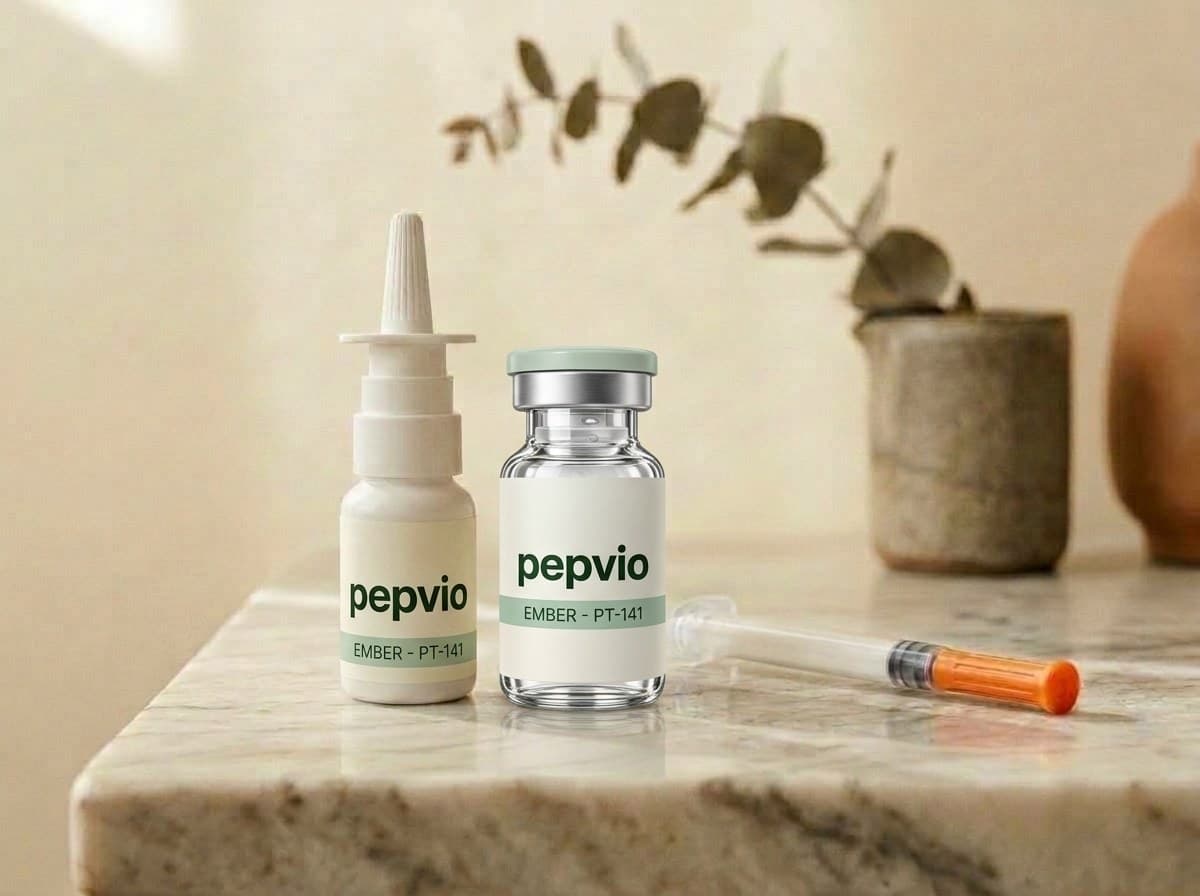
PT-141 (bremelanotide) works somewhere completely different. It doesn't touch your hormones at all: it acts on a desire signal in the brain, taken on demand before intimacy rather than every day. Because it sidesteps the hormonal change your birth control causes, it can be a way to get desire back without giving up a method that's otherwise working for you.
This is a call to make with a provider, not on your own. They'll look at the whole picture (your birth control, your history, your heart health) and decide whether PT-141 makes sense.
Key Takeaway
Frequently asked questions
Can birth control lower your sex drive?
Yes, for some women. Combined hormonal methods (pill, patch, ring) quiet your ovaries' testosterone and raise SHBG, which leaves less free testosterone to support libido. Most women notice no change or even an increase, but a smaller group (somewhere around 23 to 30 percent in the research) feels a real dip.
How long after stopping birth control does libido return?
For many women, desire comes back within a few cycles as hormone levels settle. Some research suggests SHBG can stay raised for a while after stopping the combined pill, so it isn't always instant. If desire hasn't recovered after a few months off, it's worth talking to a provider about other causes.
Which birth control is least likely to affect sex drive?
It varies person to person, but lower-estrogen formulations, certain progestins, and non-hormonal methods (like the copper IUD) tend to affect free testosterone less. The provider who manages your contraception can help you find a method that balances effectiveness with how you feel on it.
Can I treat low libido without stopping my birth control?
Often, yes. PT-141 (bremelanotide) works on a desire signal in the brain rather than on your hormones, so it can address desire without changing a method that's working for you. A licensed provider reviews your history and your contraception to decide whether it's a fit.
This article is for general information and is not medical advice. Pepvio treatments are prescription medications: a licensed US physician reviews every intake and prescribes only when clinically appropriate. Individual results vary.
Ready to get started?
A short intake form, reviewed by a licensed U.S. physician. You're only charged if a prescription is written.
See if I qualifyKeep reading
The 3 AM Wake-Up Club: What Perimenopause Does to Your Cortisol
If you fall asleep fine but wake up at 3 AM with a racing heart and a brain that won't shut off, you're not stressed. You're in a very specific perimenopausal pattern with a very specific name. Here's what's actually going on.
Read articlePT-141 in Postpartum and SSRI-Induced Low Libido: What the Mechanism Research Suggests
If you tried Addyi, switched birth control, started couples therapy, and your libido still isn't where it was (and you're either eight months postpartum or on an SSRI) there's a specific mechanism story worth understanding. Here's what PT-141 actually does, and why standard treatments often miss this exact scenario.
Read articlePerimenopause Belly Fat: What HRT Alone Doesn't Fix
You started HRT a year ago. The hot flashes went away. The mood is steadier. The sleep is much better. The belly fat that showed up around 44 is still there, and looked at squarely, it might even be slightly worse. Here's why HRT alone often doesn't address this specific problem, and what's actually upstream of it.
Read article